Shattering the Mirror of Digital Dysmorphia
What happens to the teenage psyche when reality is systematically replaced by a distorted, idealised simulation?
Every day, millions of teenagers around the world look at themselves not through the reflection of a traditional mirror, but through the glowing screen of a smartphone. Before an image is shared with friends or strangers, it is often softened, reshaped or perfected by filters designed to enlarge eyes, smooth skin and subtly alter facial features.
For many young people, these digital enhancements are no longer playful effects. They have become a new standard against which they measure themselves.
What happens when adolescence—a time of self-discovery, vulnerability and identity formation—is increasingly experienced through an idealised version of ourselves?
This question lies at the heart of The Eyes Don't Lie, Youmanity's international awareness campaign and photographic project, created to explore the impact of digital culture on body image, identity and adolescent well-being.
Conceived by Angelo Iudice, Chair of Youmanity, and brought to life through the photography of acclaimed Italian photographer Nico Nardomarino of Studio Reportage, the project brings together art, scientific research and public engagement to encourage a new conversation about authenticity in the digital age.
A Collaboration Between Art, Science and Community
The Eyes Don't Lie is built upon an interdisciplinary partnership that reflects the complexity of the issues it explores.
Alongside Youmanity and Studio Reportage, the project is supported by the Carelli Institute and ITACA Cooperativa Sociale, organisations committed to education, social inclusion and community well-being.
Its scientific foundations are strengthened by two internationally respected clinicians whose work approaches the same challenge from complementary perspectives.
Dr. Neelam Vashi, Associate Professor of Dermatology at Boston University and Director of the Boston University Cosmetic and Laser Center, has become internationally recognised for her pioneering research into skin of colour, pigmentary disorders and the psychological impact of social media on body image. Her work introduced the now widely recognised concept of Snapchat Dysmorphia, describing the growing phenomenon of individuals seeking cosmetic procedures to resemble filtered versions of themselves rather than their natural appearance.
Alongside her, Dr. Giovanni D'Alessandro, dermatologist specialising in Morphodynamic Aesthetic Surgery and author of The Mirror Is Not Enough, brings decades of clinical experience demonstrating that aesthetic concerns cannot be understood by looking only at the face. His work reminds us that requests to change our appearance often reflect deeper questions of identity, self-perception and emotional well-being. As he argues, the mirror alone is rarely enough to understand the person standing in front of it.
Together, these partners contribute to a project that seeks not only to raise awareness but also to foster healthier conversations between young people, families, educators, healthcare professionals and society as a whole.
An Italian Story with Global Relevance
Although the challenges explored by The Eyes Don't Lie feel unmistakably contemporary, their scientific roots stretch back almost 140 years.
In 1886, Italian psychiatrist Enrico Morselli introduced the term dysmorphophobia to describe the distress experienced by individuals who believed themselves to be physically flawed despite little or no objective evidence. More than a century later, the mirror that troubled Morselli's patients has largely been replaced by the smartphone screen.
Technology has transformed the medium.
Human vulnerability has changed far less.
Today, scientific research suggests that constant exposure to idealised digital images can contribute to body dissatisfaction, anxiety and unrealistic expectations, particularly during adolescence, when identity is still developing.
Yet there is another, often overlooked, contradiction.
Over recent decades, society has made significant progress towards embracing greater diversity in beauty, recognising differences in age, ethnicity, skin tone and individual appearance. At precisely the same time, digital algorithms have quietly begun rewarding increasingly standardised ideals of beauty, encouraging millions of young people to compare themselves with images that no real person can consistently achieve.
It is one of the defining paradoxes of our digital age.
The Eyes Don't Lie
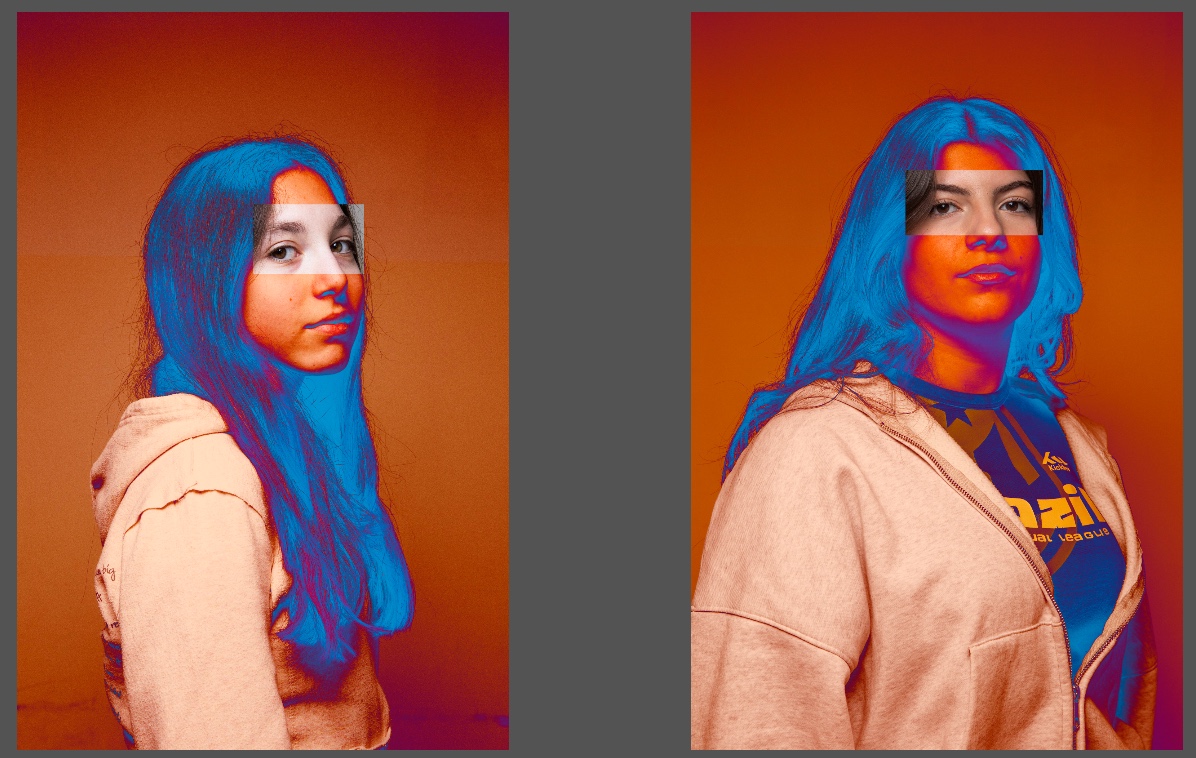
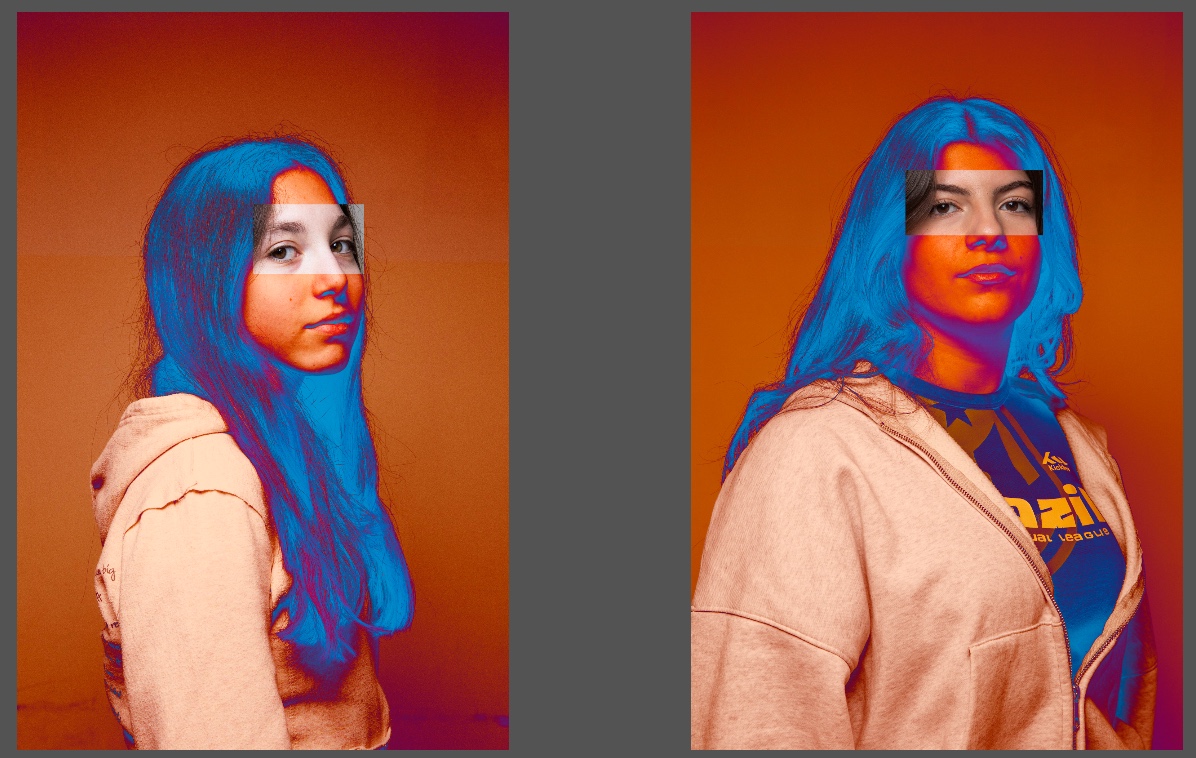
Nico Nardomarino's photographs respond to this paradox through a simple yet powerful artistic gesture.
Using a vibrant visual language inspired by the saturated aesthetic of contemporary social media, each portrait reflects the colourful, carefully curated world in which many teenagers now live.
Then the illusion breaks.
Across the centre of every face, a rectangular strip remains completely untouched by digital manipulation.
Only the eyes are left exactly as they are.
They become the emotional centre of each portrait—the place where authenticity quietly resists perfection.
The project does not seek to criticise technology or blame young people for embracing digital culture. Instead, it asks us to pause and look beyond the filter.
Every face carries its own history.
Every expression tells a story.
Every pair of eyes reveals something that no algorithm can manufacture.
Photography as a Catalyst for Change
The Eyes Don't Lie is far more than a photographic exhibition.
It is an evolving international platform that uses photography as a catalyst for research, education and public dialogue around one of the defining social challenges facing today's generation.
Through exhibitions, educational programmes, public discussions and interdisciplinary collaboration, the project seeks to encourage a culture in which authenticity is valued more highly than digital perfection, and where every young person feels empowered to recognise their own worth beyond the screen.
Because perhaps the most important question we can ask the next generation is not how they wish to appear online—
but whether they still recognise the extraordinary person looking back at them when the filter is gone.