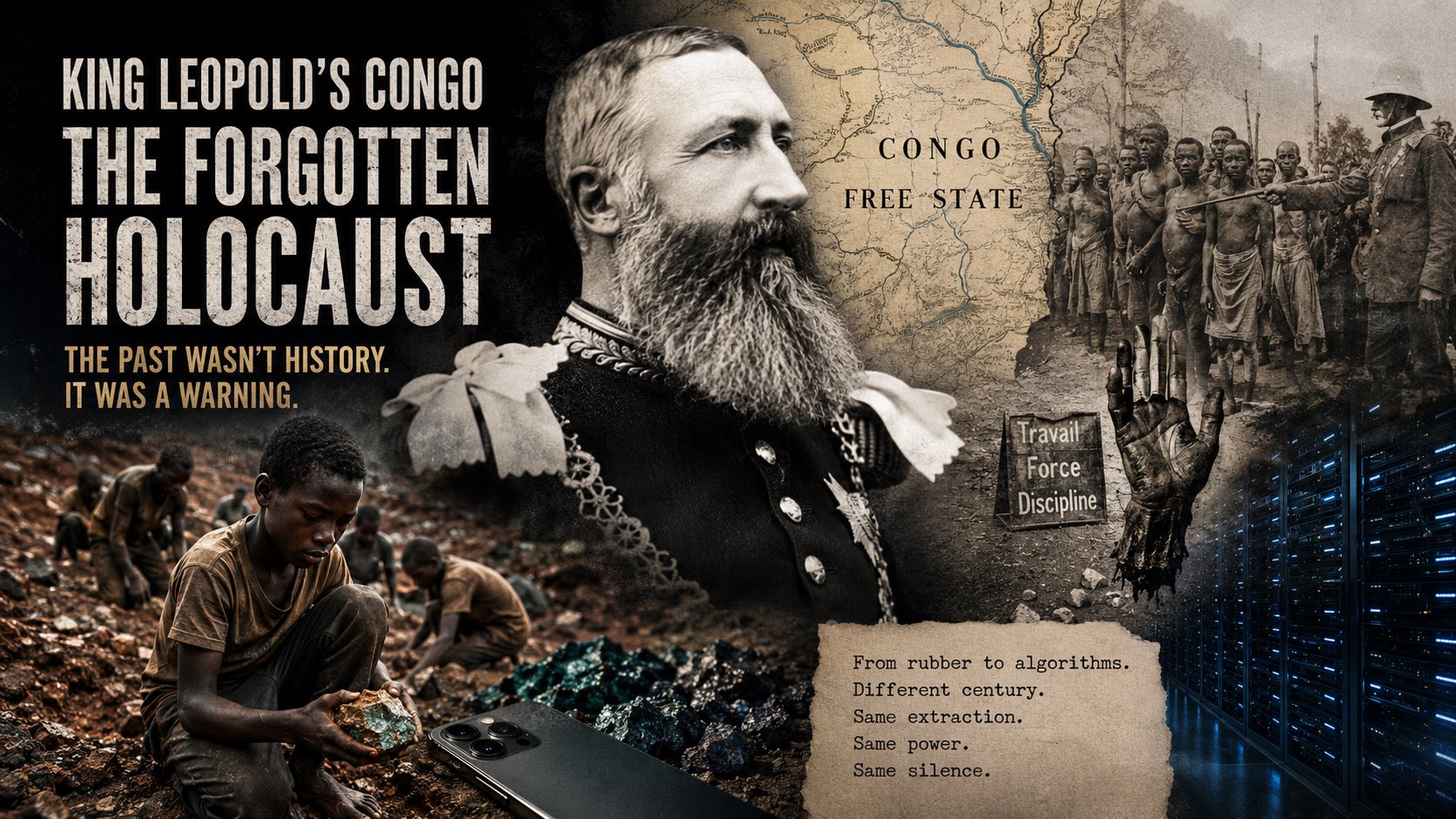
From Rubber to Algorithms: What King Leopold's Congo Can Teach Us About Power Today
History has a curious habit of remembering the powerful and forgetting their victims.
History has a curious habit of remembering the powerful and forgetting their victims.
More than a century ago, one of the deadliest humanitarian catastrophes in modern history unfolded in Central Africa. Millions of Congolese men, women and children suffered under the rule of King Leopold II of Belgium, yet for generations this tragedy remained largely absent from school textbooks, public discourse and collective memory.
Today, as societies around the world debate historical accountability, colonial legacies, cultural restitution and racial justice, the story of the Congo Free State demands renewed attention.
The Colony Owned by One Man
In 1885, King Leopold II secured international recognition for his control of a vast territory in Central Africa known as the Congo Free State. Remarkably, this was not initially a Belgian colony but the personal possession of a single monarch.
Covering an area approximately eighty times larger than Belgium itself, the territory contained immense natural wealth. Leopold presented his project as a humanitarian mission designed to bring civilisation, Christianity and economic development to Africa. Behind the carefully crafted image, however, a brutal system of exploitation was taking shape.
The global demand for rubber exploded during the late nineteenth century with the growth of the bicycle and automobile industries. The Congo contained one of the world's richest sources of wild rubber vines, and Leopold saw an opportunity to amass enormous wealth.
What followed was a regime of forced labour enforced through violence, intimidation and terror.
Rubber, Terror and Human Suffering
Entire communities were compelled to meet rubber collection quotas. Villages that failed to deliver were often subjected to severe punishment. Homes were destroyed, hostages taken, and countless people were beaten, mutilated or killed.
One of the most infamous symbols of the period was the severed hand. Soldiers were required to account for the ammunition they used, leading to the collection of hands as proof that bullets had not been "wasted." Historical evidence suggests that this horrific practice contributed to widespread mutilation and abuse across the territory.
The exact number of victims remains debated by historians, but many estimate that the population of the Congo declined by millions during Leopold's rule through a combination of violence, forced labour, disease and starvation.
While the Congolese suffered, Leopold used the profits extracted from the colony to finance grand building projects and monuments in Belgium, many of which still stand today.
The Power of Narrative
One reason the atrocities remained hidden for so long was the effectiveness of Leopold's public relations campaign.
He portrayed himself internationally as a philanthropist, explorer and humanitarian. It took the efforts of missionaries, journalists, diplomats and activists to expose what was happening in the Congo. Their campaign eventually generated international outrage and became one of the earliest global human rights movements.
In 1908, facing mounting pressure, Leopold relinquished control of the territory, which became the Belgian Congo.
Yet the end of his personal rule did not erase the consequences of decades of exploitation.
Why This Story Matters Today
The Congo is not merely a historical tragedy. It raises questions that remain deeply relevant in the twenty-first century.
Across Europe and North America, societies continue to wrestle with the legacy of colonialism. Museums face increasing scrutiny over artefacts acquired during imperial rule. Communities are asking whether monuments should honour individuals whose wealth was built on oppression. Governments are debating apologies, reparations and historical responsibility.
In Belgium, discussions surrounding Leopold II have intensified over the past decade. Some statues have been removed, relocated or reinterpreted. Others remain in public spaces accompanied by calls for greater historical context.
The question is no longer simply whether monuments should stand or fall. It is whether societies are willing to confront uncomfortable truths about how wealth, power and national prestige were accumulated.
Beyond Statues
Public monuments are often at the centre of these debates, but statues are only symbols.
The larger issue concerns education.
Many people can identify famous European monarchs, explorers and military leaders, yet know little about the millions of Africans whose lives were shaped or destroyed by colonial rule. The absence of these stories from mainstream education creates a distorted understanding of world history.
Removing a statue may spark a conversation. Learning the history behind it can transform understanding.
The challenge is not to erase history but to tell it more honestly.
The Colonialism Debate
Whenever the legacy of empire is discussed, a familiar argument often emerges: that colonialism helped build modern nations, funded magnificent cities, and brought infrastructure, education and development to territories that lacked them.
Some point to grand boulevards, museums, railways and public buildings across Europe as evidence of colonialism's positive legacy. Others argue that colonial powers introduced roads, schools and hospitals to parts of Africa, Asia and the Americas that had previously lacked modern infrastructure.
Yet this raises a difficult moral question. Can material progress justify human suffering?
To many, suggesting that colonial exploitation was acceptable because it financed development elsewhere is akin to arguing that the destruction of one people can be excused if another society benefits. Wealth created through coercion, dispossession or violence cannot easily be separated from the human cost at which it was obtained.
The claim that colonial powers arrived primarily to "civilise" indigenous populations is also increasingly challenged by historians. In the Congo, railways, roads and transport networks were not built primarily to improve the lives of local communities. They were constructed to move rubber, ivory and other resources from the interior to European markets. Infrastructure often served the economic interests of colonial administrations and private companies long before it served the needs of the people living there.
This does not mean that every road, school or hospital built during the colonial era was without value. It means that we must be honest about why many of these projects were undertaken and who benefited most from them.
Perhaps the most enduring legacy of colonialism was not civilisation, but hierarchy: systems that divided people according to race, origin and status. Across much of the colonial world, segregation became embedded in law, governance and everyday life. The consequences of those divisions continue to shape societies today.
Understanding this complexity does not require us to reject history. It requires us to confront it in its entirety—its achievements, its contradictions and its victims.
From Colonialism to Digital Colonialism
Many people view colonialism as a chapter that ended with independence movements during the twentieth century. Yet some scholars, activists and technologists argue that new forms of extraction continue today, albeit through different means.
The Congo itself provides a striking example. The country possesses vast reserves of cobalt, coltan and other minerals essential for smartphones, electric vehicles, batteries and digital technologies. While these resources power the modern world, the communities living closest to them often see only a fraction of the wealth they generate.
The parallels with the colonial era are uncomfortable. Once, rubber was extracted to fuel Europe's industrial revolution. Today, strategic minerals are extracted to fuel the world's digital revolution.
At the same time, a new debate is emerging around what some call "digital colonialism."
In the nineteenth century, colonial powers extracted land, labour and natural resources. In the twenty-first century, technology companies collect vast quantities of data, shape digital infrastructure and influence how information flows across the globe. Critics argue that data has become the new resource, and that power increasingly belongs to those who control it.
Artificial intelligence adds another layer to the conversation. AI systems are trained on enormous datasets that often reflect historical inequalities and cultural biases. When the voices, languages and experiences of entire populations are underrepresented, technology can unintentionally reinforce existing forms of exclusion.
The challenge facing humanity today is therefore not entirely different from the challenge faced in Leopold's time. It is the question of who benefits from progress, who bears its costs, and whose voices are heard when decisions are made.
The Legacy Continues
The story of Leopold's Congo reminds us that human rights abuses do not occur in a vacuum. They are often enabled by economic interests, political power and the ability to control narratives.
Remembering the past is therefore not an act of guilt. It is an act of responsibility.
As we debate justice, identity, technology and historical memory in our own time, the voices of those who suffered in the Congo deserve to be heard—not as a footnote to history, but as a warning about what happens when profit, power and human dignity are placed in conflict.
The question is not whether we can change the past.
The question is whether we are willing to learn from it.